
Ceiling Medallion Sizes: How to Choose
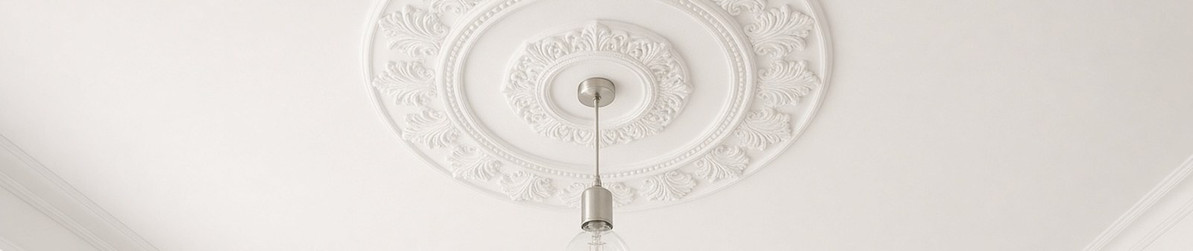
A ceiling medallion is one of the simplest ways to make a light fixture look intentional and to give a plain ceiling some architecture. The hardest part is picking the size. Too small and it hides behind the canopy; too big and it competes with the chandelier. This guide gives you simple rules for sizing a medallion to your fixture, your room and your ceiling height, with a quick-reference chart. When you are ready, browse our full range of ceiling medallions.
Start With the Fixture
The medallion frames the light, so the fixture is the best place to start. Measure the widest point of the chandelier or pendant, then use these guidelines:
- Chandeliers: choose a medallion about one-half to two-thirds the chandelier's width. A 30 in chandelier looks right with a 16 to 20 in medallion; a 40 in chandelier with a 24 to 28 in medallion.
- Pendants and flush mounts: small fixtures can sit on a medallion that is wider than the fixture itself. Here the medallion adds presence the fixture lacks.
- Ceiling fans: stay well inside the blade span and allow clearance between the blades and the medallion's raised detail.
- No fixture: a medallion can stand alone as a focal point in a foyer or great room; size it to the room instead.
Also check the canopy. The canopy must cover the medallion's center opening, and the medallion should be noticeably wider than the canopy so it reads as a frame, not a collar.
Then Check the Room
A simple room-based check keeps the medallion in proportion with the space around it. Add the room's length and width in feet; the result is a rough upper limit for medallion diameter in inches in a room with an 8 ft ceiling. A 12 x 14 ft dining room (26) is comfortable with a medallion up to about 26 in. Then compare with the chart:
| Room | Typical size | Spectis examples |
|---|---|---|
| Powder room, hall, small bedroom (under ~12 x 12 ft) | 12 to 20 in | 12⅜ in oval-bead, 15 in smooth dish, 17 in floral sunburst, 18 in beaded rim |
| Dining room, bedroom, kitchen | 20 to 30 in | 20½ in scalloped sunburst, 24 in leaf rim, 25⅛ in leaf and rope, 27½ in smooth stepped |
| Living room, family room | 28 to 36 in | 31 in bead and reel, 32½ in acanthus scroll, 36 in large leaf |
| Foyer, two-story room, great room | 36 to 60 in | 45 in acanthus leaf, 45¼ in ornate rococo, 60 in acanthus leaf |
| Long table or rectangular room | Oval or oblong | 12 x 21 in and 27 x 17½ in oblong, 46 x 71 in oval, 29¾ x 41⅝ in rectangle |
Ceiling Height Matters
Height changes how big a medallion looks from the floor. On a standard 8 ft ceiling, stay at or slightly under the room guideline, and favor flatter designs with low projection so the ceiling does not feel lower. On 9 to 10 ft ceilings, go one size up. In foyers and two-story rooms, detail is hard to see from 15 or 20 ft away, so choose a large, bold design, often 36 in or more, with deep relief.
Match the Shape to the Space
Round medallions suit most rooms and fixtures. Over a long dining table or in a narrow room, an oval, square or diamond ceiling medallion follows the lines of the space and looks more deliberate. Square medallions work well with square tables and coffered or boxed ceilings.
Pick a Style
Once the size is set, choose the style to match the room. Smooth and stepped medallions work in modern and transitional spaces. Beaded and rope rims add a fine classic edge. Leaf and scroll borders keep a plain center for a clean canopy fit. Floral and sunburst designs radiate out from the light, and ornate scroll and acanthus medallions suit formal and period rooms.
Center Holes and Fixture Fit
Spectis lists the overall size first and the center hole second, for example 32½ in diameter x 4 in hole. Always order by overall size. Center openings range from about ¾ in to 6 in, and some models have a solid center. Check that the fixture canopy is larger than the hole. If you need to enlarge an opening, polyurethane cuts cleanly with a hole saw, but ask us first on detailed centers.
Worked Examples
Dining room, 12 x 14 ft, 9 ft ceiling, 28 in chandelier. Half to two-thirds of 28 in is 14 to 19 in. The room check allows up to about 26 in, and the 9 ft ceiling lets you go a little larger. An 18 to 24 in medallion, such as a beaded rim, leaf rim or floral design, is a safe, balanced choice.
Bedroom, 11 x 12 ft, 8 ft ceiling, flush-mount light 14 in wide. A flush mount benefits from a medallion wider than the fixture. A 17 to 20 in medallion with low projection frames the light without lowering the ceiling visually; a smooth stepped or leaf-border design keeps the look quiet.
Two-story foyer, 16 x 18 ft, 40 in chandelier. The fixture rule suggests 20 to 27 in, but in a tall foyer the detail needs to read from far below. Step up to a 32 to 45 in ornate or acanthus medallion with deep relief so it holds its own at height.
Family room, 15 x 18 ft, 52 in ceiling fan. Keep the medallion well inside the blade sweep. A 20 to 24 in medallion with a plain center and modest relief leaves blade clearance and still gives the fan a finished base.
Rooms With More Than One Fixture
Over a long island or table with two or three pendants, use either one oval or oblong medallion that spans the group, or a matching smaller round medallion over each pendant. Keep the spacing even and the style consistent. In an open-plan space, use the same medallion family throughout and scale the size to each zone, larger over the dining table and smaller over the kitchen island or entry.
Common Sizing Mistakes
- Ordering by hole size instead of overall diameter.
- Choosing a medallion wider than the chandelier, which makes the light look small.
- Using a medallion wider than a ceiling bay or coffer, so it cannot sit flat.
- Ignoring fan clearance between the blades and raised detail.
- Choosing a delicate, low-relief design for a very high ceiling, where the detail disappears.
Installing Your Medallion
Spectis medallions are high-density polyurethane, primed white and ready to paint, and light enough to install without special framing. Switch off the circuit, lower the canopy, center the medallion over the box, bed the back in ADH100 polyurethane adhesive and fasten into joists or blocking. Fill, caulk and paint, then rehang the fixture. The medallion is decorative only; the fixture must stay supported by its own rated box. Our ceiling medallion installation guide has the full steps, and finishing Spectis urethane products covers paint and glaze.
Ceiling Medallion Size FAQs
What size ceiling medallion do I need for a chandelier?
A medallion about one-half to two-thirds the width of the chandelier usually looks balanced. For a 24 in chandelier, look at medallions of roughly 12 to 16 in; for a 36 in chandelier, 18 to 24 in.
Should a ceiling medallion be bigger than the light fixture?
Usually not for a chandelier, which should remain the star. For a small flush mount or pendant, a medallion wider than the canopy and fixture is normal and helps the light look more substantial.
What size medallion for a dining room?
Most dining rooms take a 20 to 30 in medallion. For a long table, consider an oval or oblong medallion that follows the table's shape.
What size medallion for a ceiling fan?
Choose a medallion clearly smaller than the blade span, with enough clearance between the blades and the raised detail. A 15 to 24 in medallion suits most 44 to 52 in fans.
Does ceiling height change the size?
Yes. On 9 ft and higher ceilings go one size up so the detail reads from the floor. On 8 ft ceilings, a flatter, low-projection medallion keeps the room open.
How do I measure a ceiling medallion?
Measure overall diameter, or width and length for shaped medallions. The center-hole size is separate; the fixture canopy must cover it.
Recent Posts
-

Ceiling Medallion Sizes: How to Choose
A ceiling medallion is one of the simplest ways to make a light fixture look intentional and to give …Oct 10th 2026 -

What Is a Corbel? Types, Sizes & How to Choose Exterior Corbels
Corbels are one of the oldest details in architecture, and one of the easiest ways to add depth and …Oct 10th 2026 -

Types of Mouldings: A Visual Guide
Mouldings are the trim that finishes a room or a facade: they cover joints, frame openings and add …Oct 10th 2026