
What Is a Corbel? Types, Sizes & How to Choose Exterior Corbels
Corbels are one of the oldest details in architecture, and one of the easiest ways to add depth and character to a plain roofline, porch or mantel. This guide explains what a corbel is, the main types, where they are used, how to size them and how to choose between polyurethane, PVC and wood. When you are ready to shop, browse our full range of exterior corbels.
What Is a Corbel?
A corbel is a bracket-shaped piece that projects from a wall and supports, or appears to support, something above it. In stone and brick buildings, corbels were structural: masons stepped stones out from the wall to carry a beam, balcony or roof edge. Timber builders did the same with carved wood blocks under beams and eaves.
Today most corbels are decorative. They give the look of support and craftsmanship without carrying the load. The roof, beam or shelf is held up by its own framing, and the corbel finishes the joint visually. That is how Spectis corbels are designed: as decorative trim in high-density polyurethane, primed white and ready to paint.
Corbel vs Bracket vs Block
People often use these words interchangeably, but there are useful differences. A corbel is usually solid and taller than it is deep, often with a scroll, leaf or panel face. A bracket is usually more open or triangular and can project further from the wall, like knee brackets or the large gable brackets that fill a roof peak. A block is compact and boxy, used along an eave line or cornice. You can compare all three in our corbels and brackets collection.
Types of Corbels
Scroll corbels
The classic shape: an S-curve or volute that rolls out from the wall, sometimes with a rosette. Scroll corbels suit traditional, Victorian and Mediterranean homes, under eaves and mantels alike.
Acanthus corbels
These carry carved acanthus leaves, and sometimes grapes, on the face. Acanthus corbels are the most ornate option and work well where they are seen up close, such as a fireplace, entry or kitchen hood. The Acanthus Scroll Exterior Corbel (BL2400) is a good example.
Fluted corbels
Fluted corbels have vertical grooves like a classical column or pilaster. They give a crisp, tailored look and pair well with fluted pilasters and columns.
Panel corbels
Panel corbels have a recessed or raised panel on the front instead of carving. They fit Craftsman, transitional and simpler traditional styles.
Smooth corbels
Clean ogee, cove and curved profiles with no ornament. Smooth corbels are the go-to choice for modern farmhouse and contemporary exteriors, and many come in left- and right-pitch versions for sloped soffits.
Where Corbels Are Used
Under eaves
The most common exterior use. Corbels spaced along the eave add shadow and depth to a plain overhang and make the roofline look heavier and more finished. If your soffit follows the roof slope, choose a pitch version cut to match; you can shop corbels and brackets by roof pitch.
Porches and entries
Porch corbels sit where a beam or header meets a post or wall. They soften the corner and make the beam look supported. Because porches are exposed to rain, sun and humidity, a material that does not rot is a practical choice.
Mantels, shelves and kitchens
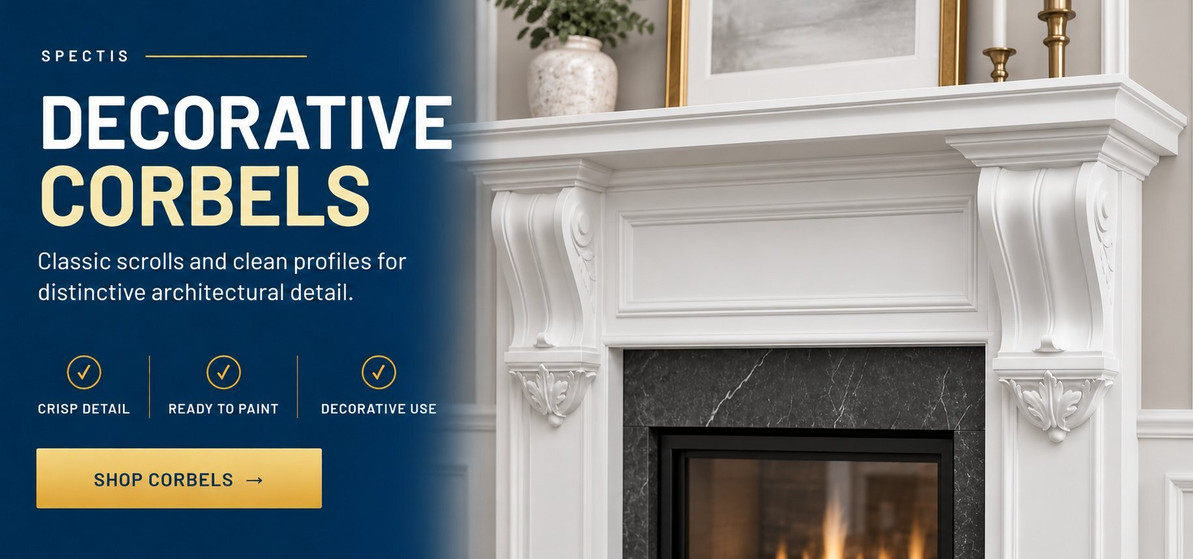
Indoors, corbels dress up the underside of a fireplace mantel, a floating shelf, a kitchen island overhang or a range hood. Remember that decorative corbels are not load-bearing: the mantel, shelf or countertop needs its own support, and the corbel adds the look.
Large exterior corbels
Tall walls, two-story entries and deep overhangs need bigger pieces to stay in proportion. Examples include the Grand Acanthus Scroll Exterior Corbel (BL2783), 54 in tall, and the Curved Decorative Eave Exterior Corbel (BL3181), with a 38 in projection.
How to Size a Corbel
Every corbel has three dimensions. Check all three, and the PDF drawing on the product page, before you order:
- Width is the face measurement, side to side. Match it to, or keep it just under, the width of the beam, rafter or post above.
- Height is top to bottom. Taller corbels look stronger and suit higher walls and deeper overhangs.
- Projection is how far the corbel extends from the wall. Measure from the finished wall to the fascia or the front of the shelf; the projection should be equal to or slightly less than that distance.
For a sloped soffit, measure the roof pitch (rise per 12 in of run) and choose the left- or right-pitch version made for it. Spectis offers pitch versions of 36 corbels for 5/12 to 15/12 roofs. You can also filter by eave depth and height.
For spacing under an eave, line corbels up with rafters, corners and the edges of windows and doors below, and keep the spacing even. On a gable, odd numbers (three or five) with one near the peak usually look balanced.
Matching Corbels to Your Home's Style
Craftsman and bungalow: simple panel or smooth corbels and knee brackets under wide eaves, often in a bold, chunky size so they read from the street.
Victorian and Italianate: scroll and acanthus corbels, frequently set in pairs along the eave, with plenty of carved detail to catch shadow.
Colonial and Georgian: fluted and panel corbels that echo pilasters, columns and dentil cornices.
Mediterranean and Spanish: deep scroll corbels and long projections under tile roofs and balconies.
Modern farmhouse and contemporary: smooth ogee and cove profiles with clean lines and little or no ornament, painted to match or contrast with the trim.
Common Corbel Mistakes to Avoid
- Choosing too small. Corbels look smaller once they are up under an eave. If you are between two sizes, the larger one usually looks better from the street.
- Ignoring the projection. A corbel that sticks out past the fascia or shelf edge looks wrong. Measure from the finished wall.
- Forgetting the slope. A straight corbel under a sloped soffit leaves a wedge-shaped gap. Use a pitch version.
- Expecting it to carry weight. Decorative corbels are trim, not structure.
- Leaving it unpainted. The primer is a base coat; finish with paint after installation.
How to Choose Exterior Corbels: Polyurethane vs PVC vs Wood
Wood is traditional and can be carved in any style, but outdoors it can rot, split and warp, and it needs regular sealing and repainting.
PVC is moisture resistant and often used for flat trim boards. Spectis does not make PVC corbels.
Polyurethane is what Spectis uses for every corbel. High-density polyurethane holds fine carved detail, will not rot, warp or crack when installed properly, and cuts, nails and glues like wood. Every Spectis corbel is primed white and ready to paint. Browse our polyurethane corbels by style and size.
How to Install a Corbel
Clean the mounting surface and make sure it is solid. Apply ADH100 polyurethane construction adhesive to every bedding face and joint, press the corbel into place and secure it with the recommended screws or finish nails into solid backing. Fill nail and screw holes, then paint with a quality latex paint. Our eave corbel and bracket installation guide walks through layout and fastening step by step.
Corbel FAQs
What is a corbel in simple terms?
A corbel is a bracket-shaped piece that sticks out from a wall and appears to hold up something above it, such as an eave, beam, mantel or shelf.
What is the difference between a corbel and a bracket?
A corbel is usually solid and taller than it is deep, often with a scroll or carved face. A bracket is usually more open or triangular and can project further from the wall.
Are Spectis corbels structural?
No. Spectis corbels are decorative polyurethane trim. They are not load-bearing and should not carry a beam, shelf, countertop or any other load on their own.
Can polyurethane corbels be used outdoors?
Yes. Spectis corbels are high-density polyurethane, which will not rot, warp or crack when installed properly, so they are widely used under eaves and on porches. They are primed white and should be painted after installation.
How do I install a corbel?
Fit the corbel to a clean, solid surface, apply ADH100 polyurethane construction adhesive to every bedding face and joint, and secure it with screws or finish nails into solid backing. Fill the holes and paint.
Shop Exterior & Decorative Corbels ›
Recent Posts
-

What Is a Corbel? Types, Sizes & How to Choose Exterior Corbels
Corbels are one of the oldest details in architecture, and one of the easiest ways to add depth and …Oct 10th 2026 -

Types of Mouldings: A Visual Guide
Mouldings are the trim that finishes a room or a facade: they cover joints, frame openings and add …Oct 10th 2026 -
How to Install Pediments and Pilasters: Door, Fireplace and Window Surrounds
A pediment over a door with a pilaster on each side is the classic door surround. It makes a plain e …Oct 9th 2026